Office work
Reads what piled up, writes what has to be written.
The models think before they answer: the steps happen, and what you get is the conclusion with the reasoning that carries it. Where a step does not carry, the answer says so instead of moving past it.
Including the part you are unsure about. A question with two readings gets a question back, not a guess.
The conclusion comes with the reasoning that carries it, not after it.
Where a step does not carry, it says so. That mark is the product.
Decisions and processes as flow diagrams, options side by side with what speaks for each.
Reasoning is not knowledge. A model that reasons well from wrong premises reaches a wrong answer beautifully. For anything current or specific, switch on web search or attach the source.
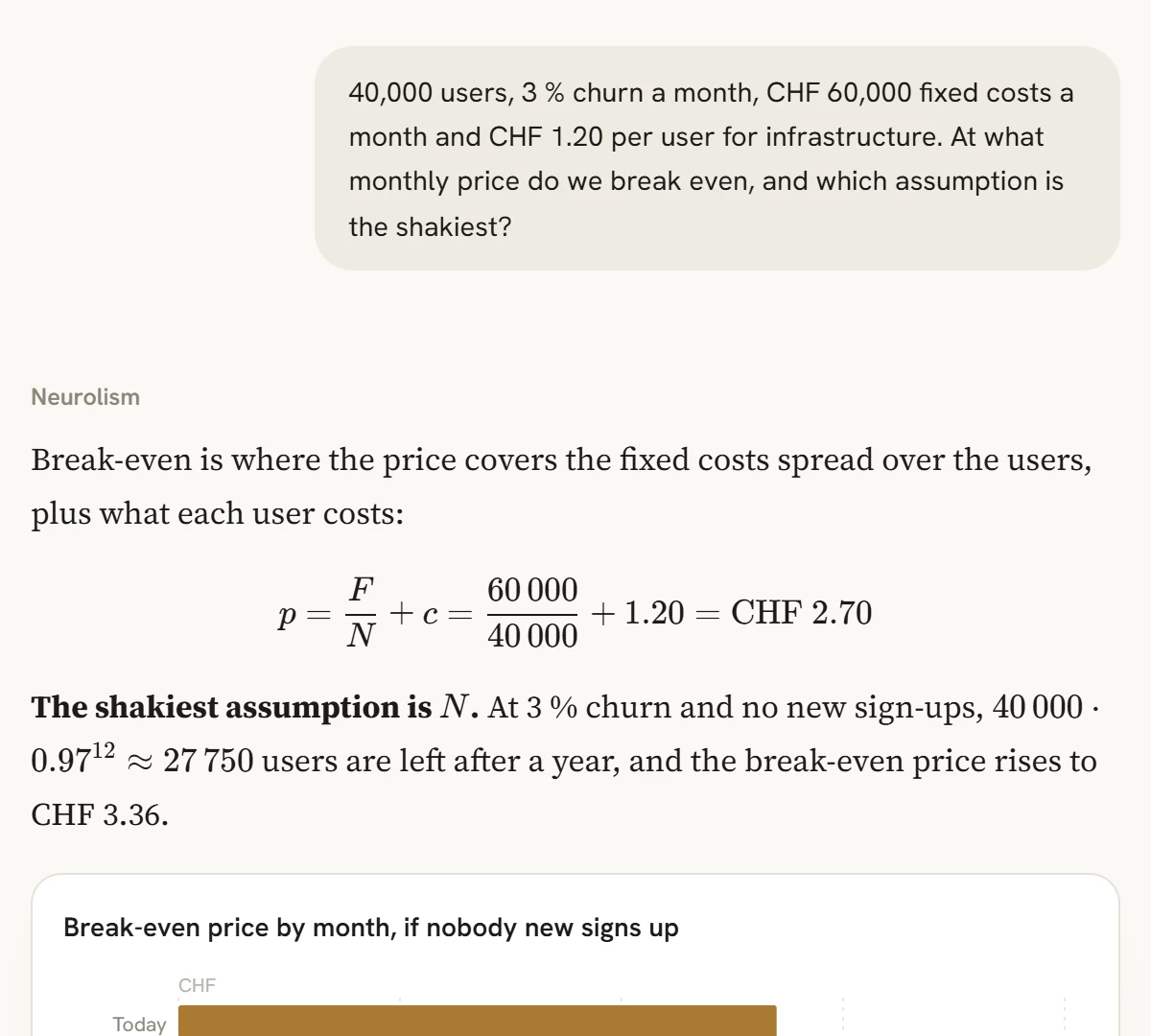
We have 40 000 users, 3 % churn a month and pay 1.20 CHF per user in infrastructure. At what price does the plan break even, and which assumption is the shakiest?
Large or Max. This is the one job where the small model is not a saving: the chain breaks in the middle and the answer sounds just as confident.
Compare the sizesThe models reason before answering. What you get is the conclusion and the reasoning that supports it - not a transcript of every branch it considered.
Because most systems say it too rarely. A confident wrong answer costs the reader more than an honest gap, and the whole design is built around measuring which one it is.
It works through maths with the steps set as proper formulas, and a graph where it helps. Working through is still reasoning, not calculating: for figures in a file you attach it runs Python in your browser and computes them, and for anything else that has to add up, check the total.
Reads what piled up, writes what has to be written.
Explanations that stop where the knowledge stops.
Reads the numbers, and refuses to be your adviser.