Companies
Own account, own keys, prepaid credit, no seat count.
Reconciliations, budgets, a spreadsheet nobody has understood since the person who built it left. It reads the numbers and shows the working - and stops short of telling you what to buy.
The bank export and the ledger, or the budget and the actuals.
Not the summary - the rows that do not match, with the amount.
It shows how each figure was reached, which is the part you can argue with.
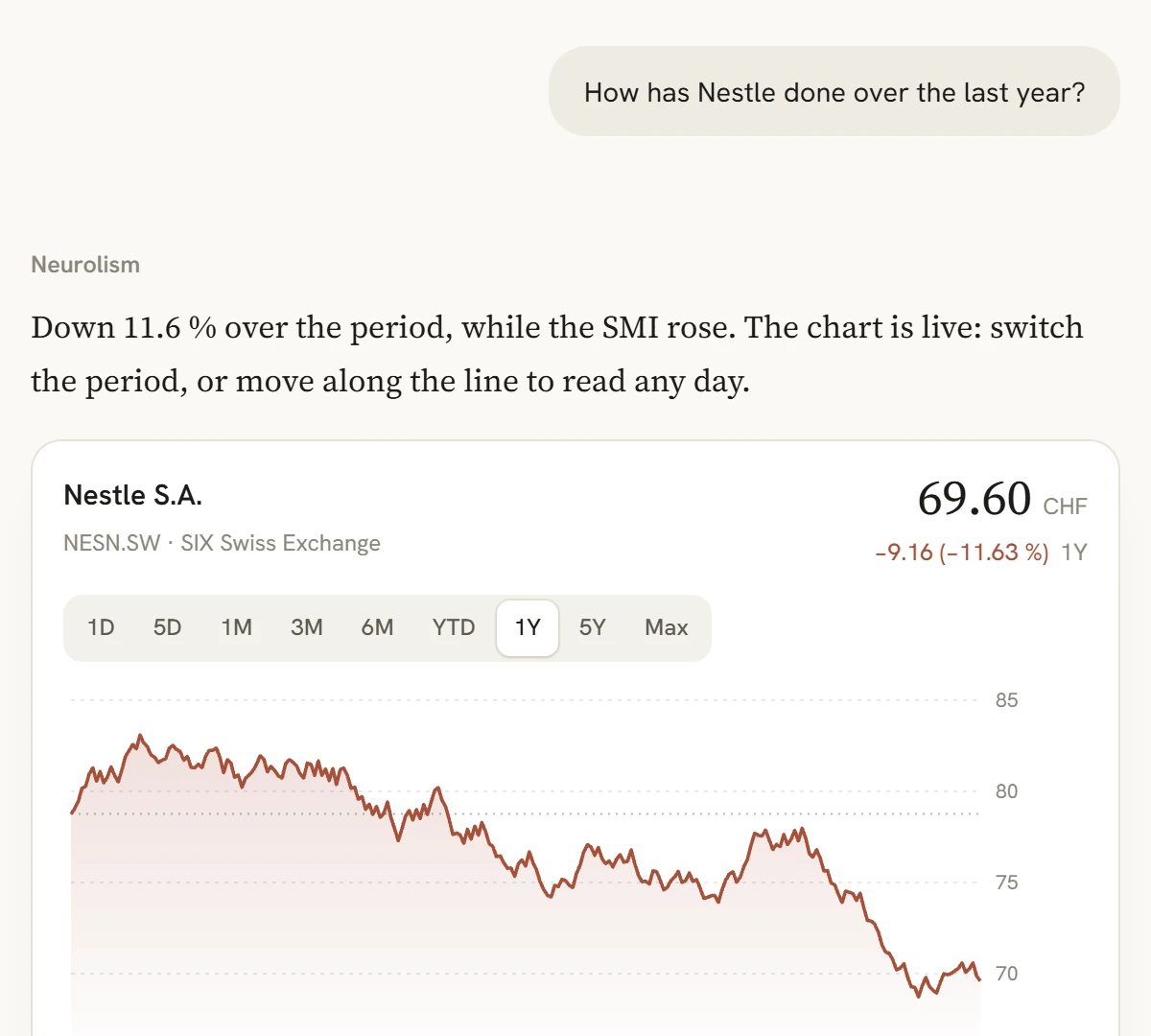
Ask about a share, a coin or an index and the answer carries a live chart with today's price. Figures from your own files become key numbers and charts.
No investment advice. Not because of a disclaimer, but because a system that produces plausible text has no business telling anyone where to put their money. Arithmetic in a language model is reasoning, not calculation: for anything that has to add up, have it show the working and check the total.
Two exports, one from the bank and one from the ledger. Find the entries that appear in one and not the other, and group them by likely cause.
Large. Arithmetic across many rows is where the small models slip quietly.
Compare the sizesNo. A system that produces plausible text has no business advising on money, and saying so is not a disclaimer - it is the reason the feature does not exist.
Yes. It reads what a cell computes, not only what it displays - which is usually where the surprise is.
Yes. Say “tell me when Nestlé falls below 70” and you get an email once the price crosses that line. Prices can be delayed, and an alert is a reminder you set, not a recommendation.
No training, no analysis, no profiling. Your figures are processed to answer your question and for nothing else.
Own account, own keys, prepaid credit, no seat count.
Swiss operator, named subprocessors, nothing used for training.
What is stored, what is not, and what you can switch off.