The parts that are actually about trust.

Everyone writes that they take privacy seriously. Here is what that means concretely, including the parts that are inconvenient for us.

Three steps.

  1. 1

    Decide what it may remember

    The profile it builds about you is visible, switchable and deletable, in one place.

  2. 2

    Use incognito where it matters

    That conversation lives in memory, is never written down, and the profile is not used.

  3. 3

    Delete what you no longer want

    A conversation, the profile, or the whole account - all without asking anyone.
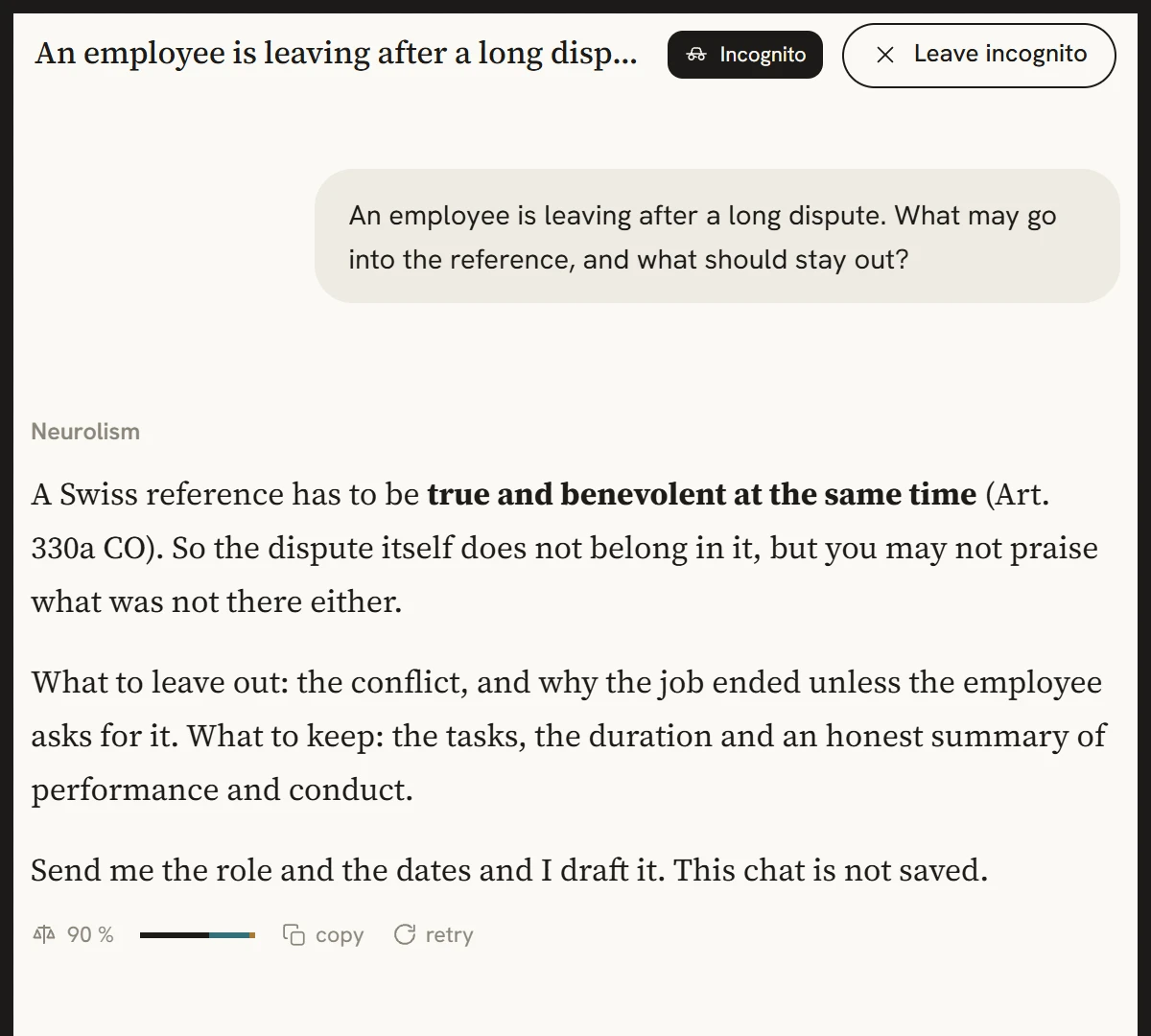
An incognito conversation about a work reference, marked in the window as not saved.
In the app. An incognito conversation about a work reference, marked in the window as not saved.

What it does.

  • No training on your conversations, on any plan - the free one included
  • No tracking, no advertising pixels, no third-party analytics, and therefore no cookie banner
  • Incognito: the conversation lives in memory and is never written down, and the profile is not used
  • The profile the model builds about you is visible, switchable and deletable, in one place
  • API keys are stored hashed: we cannot show you one again, and neither could anyone who broke in
  • Passwords hashed with Argon2id; sessions on a rotating token whose reuse ends the session
  • Connected accounts - OneDrive, Outlook, Google Drive - are read only and searched only when you ask; what it reads there goes to the model like anything you type, and you can disconnect at any time
  • A shared link shows the conversation as it was when you shared it, without attachments, and you can delete the link at any time

Where it stops

Your text goes to the company that runs the model - today DigitalOcean, in the EU and the US. We do not have a model on our own hardware yet. Health data, credentials and anything under professional secrecy should not go into any hosted model, ours included.

Which size to use

Any. This is not about the model, it is about what happens around it.

Compare the sizes

Questions.

Do you train on my conversations?

No, on any plan, the free one included. A service that trains on what its customers write has an interest in them writing more than they need to.

Who can read my conversations?

Technically, the two people who administer the servers - and they do so only when you ask for help with a specific problem. Nobody reads them routinely, and nothing is analysed.

Is there a cookie banner?

No, because there is nothing to consent to. The only cookie is the one that keeps you signed in.

Other kinds of work.

Research and sources

Looks things up, and names what it read.

Writing and editing

Edits what is there rather than rewriting it into its own voice.