Know which answers to trust.
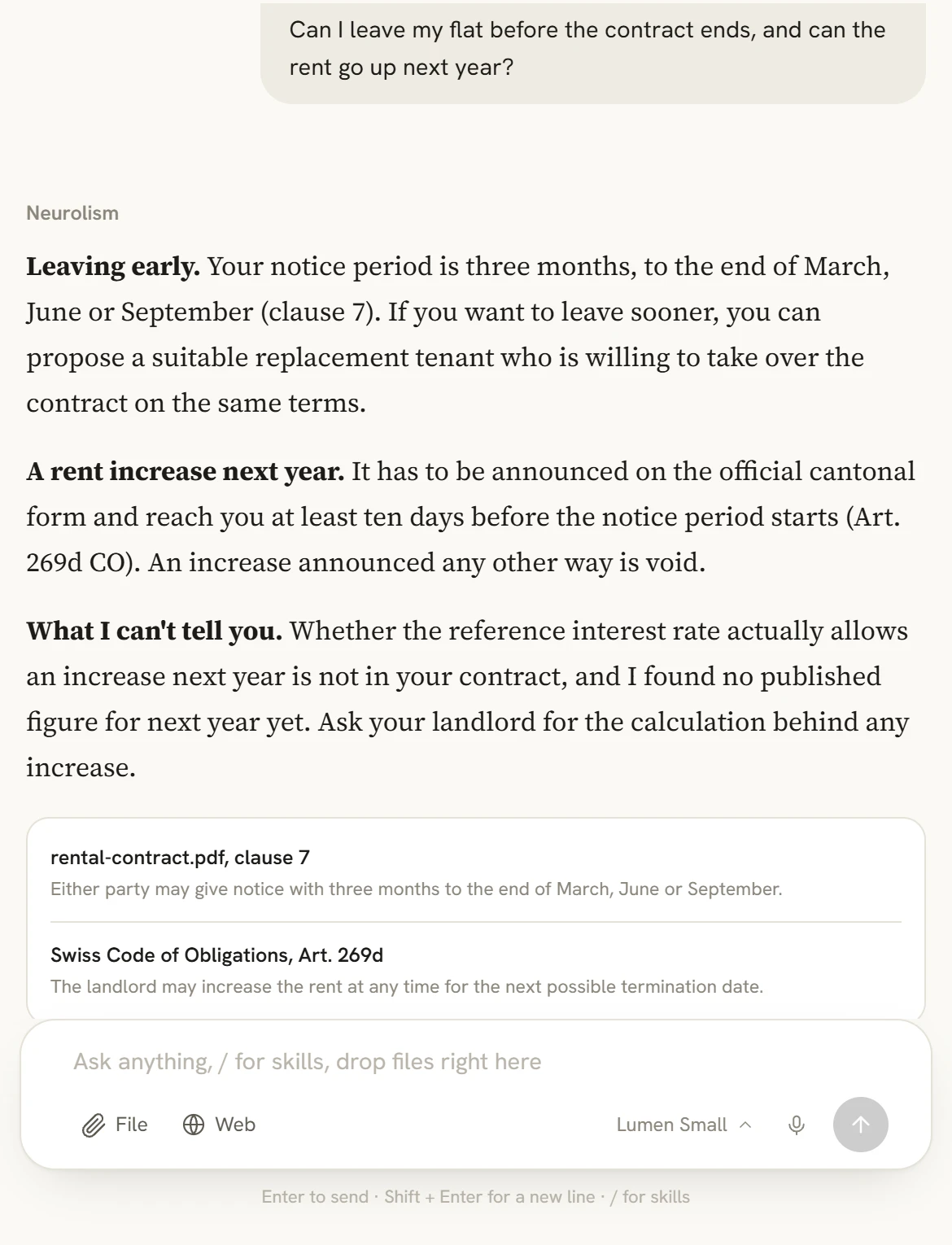
Neurolism is an AI assistant from Switzerland. It shows where every answer comes from, says plainly when it doesn’t know, and never trains on what you send.
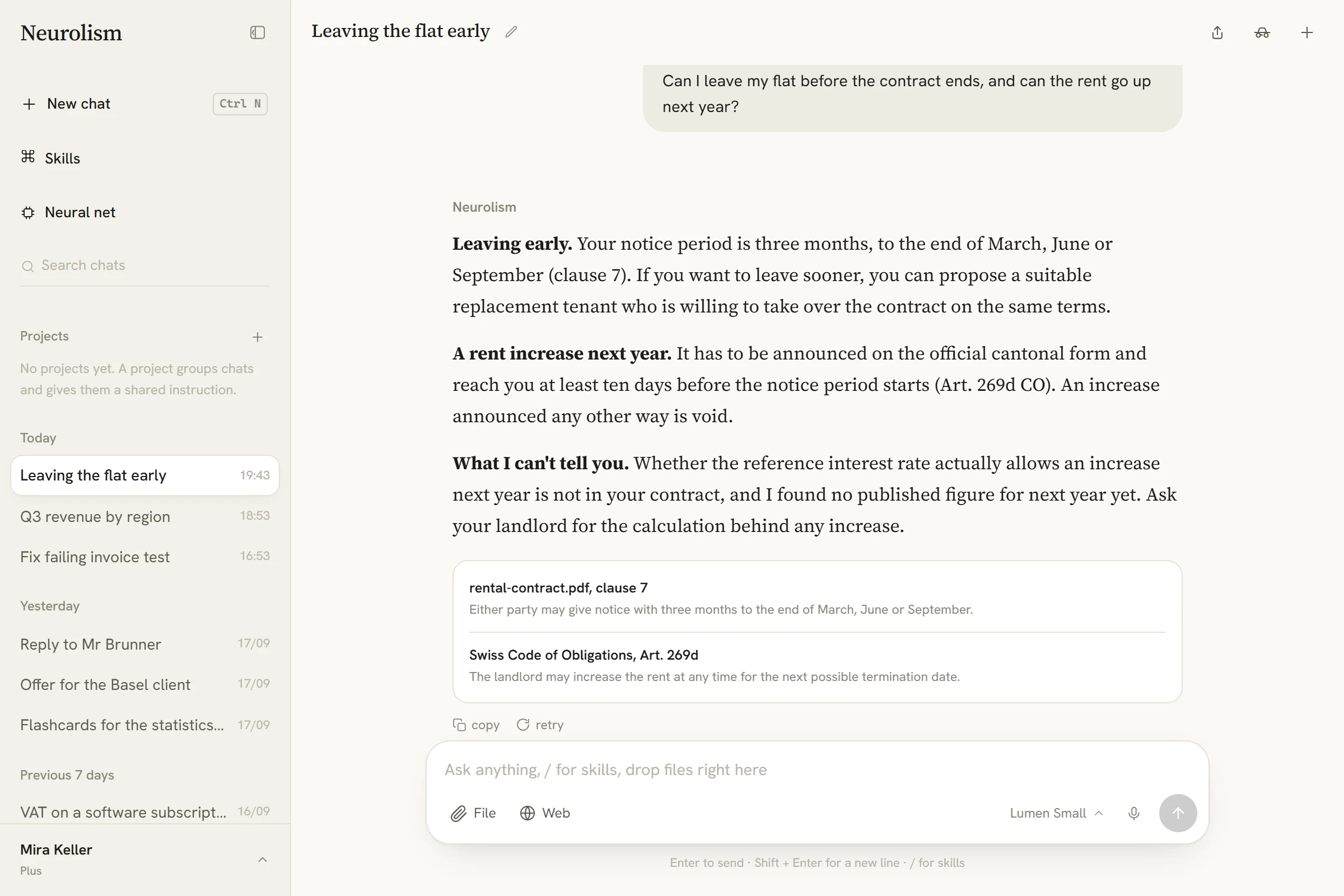
Real work, start to finish.
Not a chat window that talks about your work. One that does it, with the files you already have.
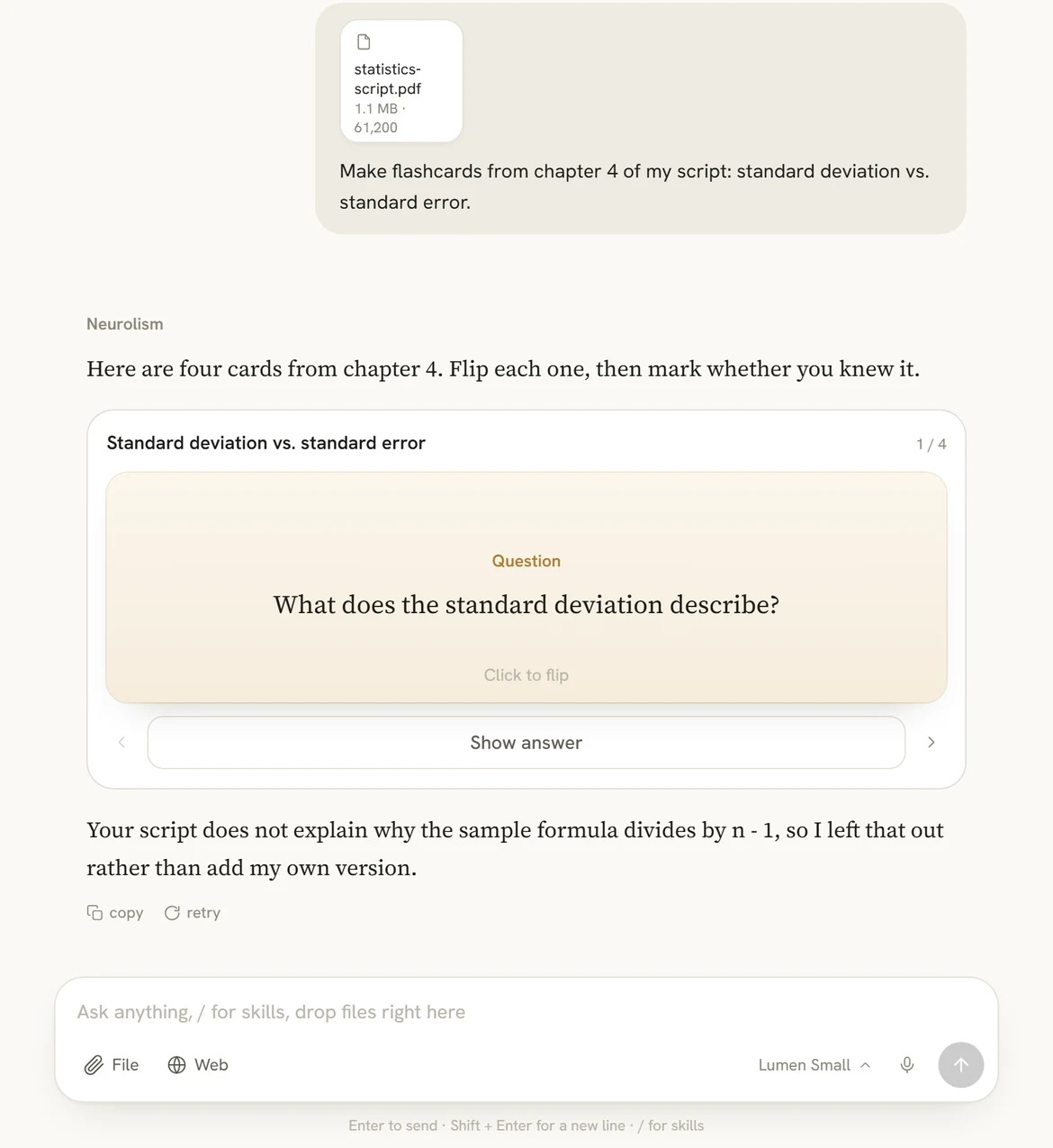
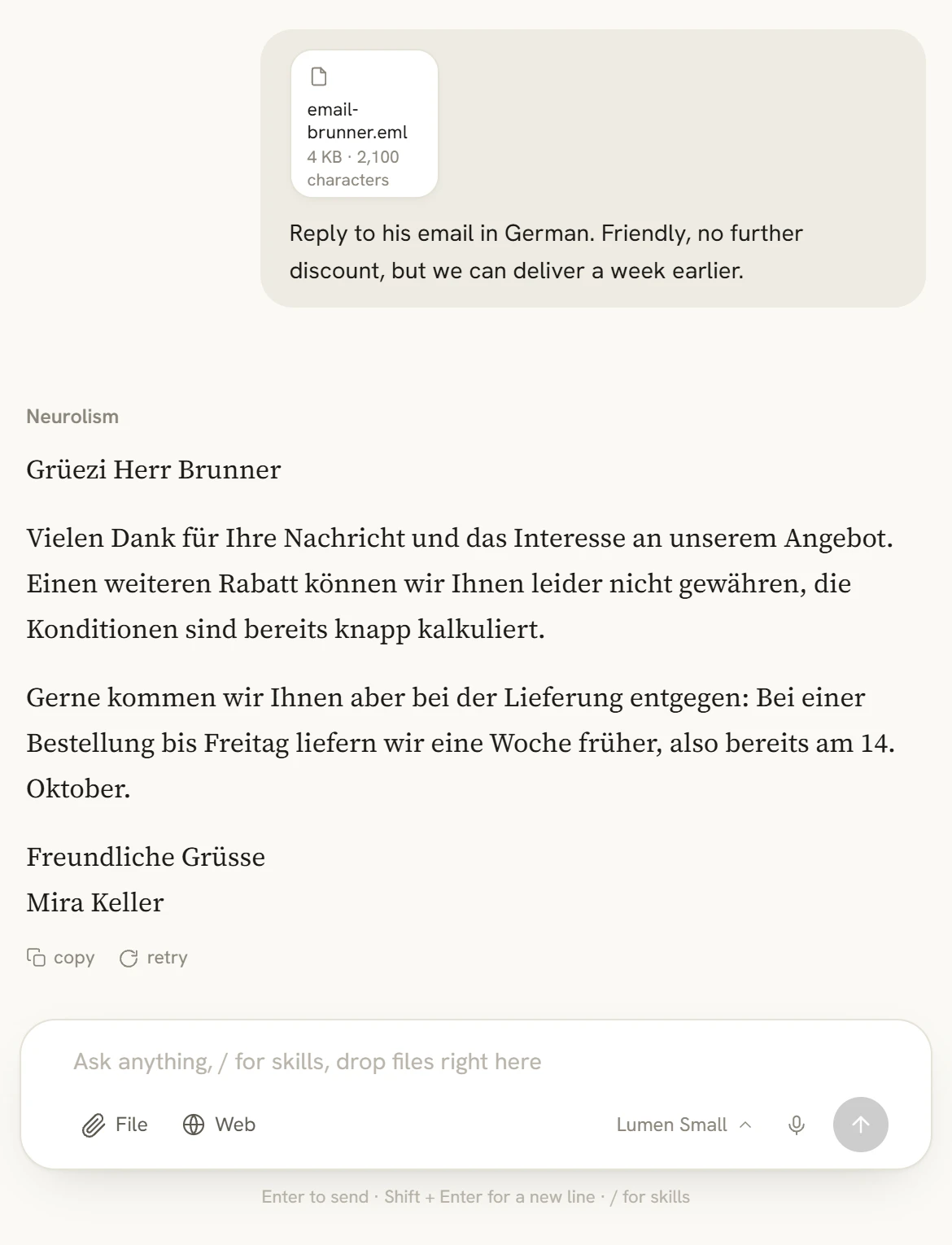
Answers you can see.
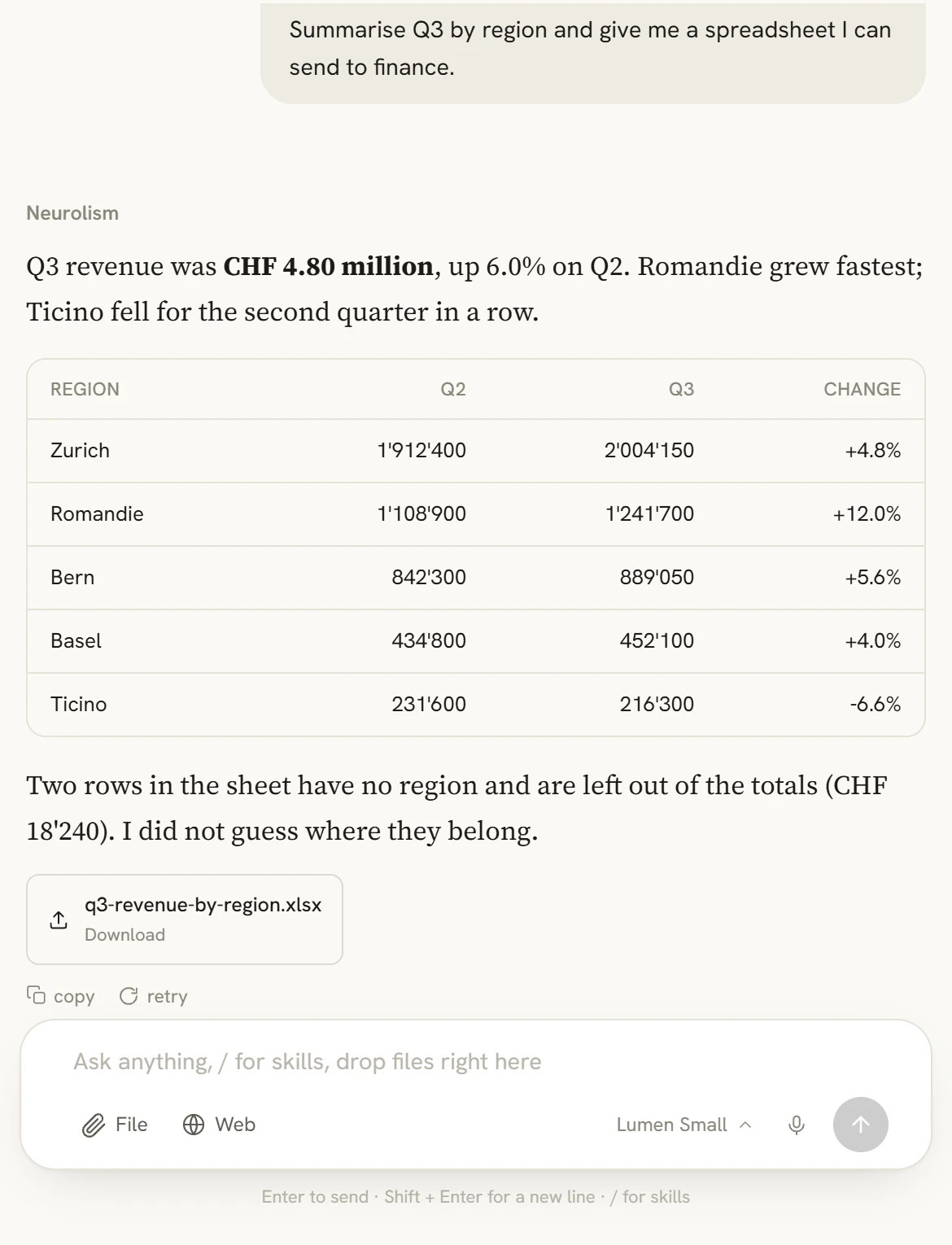
A share price over the year, a spreadsheet worked through in Python, a small app that runs, a formula set properly. Right in the answer, and live: move along them, switch them, use them.
Build on the same models.
Put Neurolism behind your own product. The API speaks the OpenAI format, so existing code usually needs a new address and a key, nothing more.
- Your own API keys, usage per key
- Prepaid credit, billed per token actually used
- Lumen Small, Medium and Large
curl https://api.neurolism.com/v1/chat/completions \
  -H "Authorization: Bearer $NEUROLISM_KEY" \
  -H "Content-Type: application/json" \
  -d '{
    "model": "neurolism-medium",
    "messages": [{
      "role": "user",
      "content": "Summarise this contract"
    }]
  }'
For your company.
One business account for the whole team: invite members, see usage per person and per key, and pay from prepaid credit instead of counting seats.
- Team accountsInvitations and one bill for everyone.
- Credit, not seatsPay for what the team actually uses.
- Swiss contractInvoices in francs, with a VAT number.
- Two-factor sign-inOn every account that holds business keys.
Your data is not the product.
The same rules for a personal account and for a company. No setting to find, no opt-out to remember.
Who processes whatNever used for training
Not for our models and not for anyone else's, on every plan.
Deleted means deleted
Removed from the database, not hidden. Your account goes in one step.
Incognito when you want it
Never stored. It exists in your window and nowhere else.
A Swiss company
Swiss contract, invoices in francs, every service provider named.
Our own architecture. Our own models.
Not a wrapper around someone else’s chatbot. At the core is a layer that compares what the model says with what the evidence says, and is allowed to answer: this does not match.
Wrong answers sound right
A separate layer compares each answer with its evidence and can say that they do not match.
Confidence nobody checks
Calibration is measured. At seventy percent confidence, about seventy percent have to be right.
Costs grow with every user
A small model answers first. Only what it cannot settle goes to a larger one.
Training data nobody can trace
For our own training, origin, licence, date and volume of every source is recorded.
Lumen
Available nowThe family answering every conversation today.
- Weights
- Open weights, fine-tuned by us
- Consistency layer
- Runs on top of the model
- Sizes
- Small, Medium, Large. Max in planning
Gauss
PlannedOur own frontier models, trained from zero.
- Weights
- Trained from zero on our own data
- Consistency layer
- Built into the architecture
- Proof
- A 1.16-billion-parameter model already runs
Research, written down.
What we measured, what we got wrong, and why the system is built the way it is.
Start free.
Upgrade when you need more room. Swiss francs, VAT included.
Questions
Is anything I send used for training?
No. Conversations, files and prompts are never used to train our models or anyone else's, on every plan including the free one.
What are Lumen and Gauss?
Our two model families. Lumen answers today: open weights we fine-tune, with our own consistency layer on top, in Small, Medium and Large, with Max in planning. Gauss is planned: weights trained from zero with that layer built into the architecture. A 1.16-billion-parameter model of it already runs; the larger sizes need funding.
Can it draw charts and diagrams?
Yes, right in the answer: live stock and crypto charts, bar and line charts, org charts, timelines, comparison tables, maps with routes, maths set as proper formulas, and flow, sequence or use case diagrams. Ask for one, or it draws one when the numbers have a shape worth seeing.
Can it run calculations and code?
Yes. It runs Python in your browser for statistics, pivots and regressions on the files you attach, so figures are computed rather than estimated, and the analysis itself runs on your computer. Web pages and small React apps it writes run as a live preview next to the answer, and you can edit the code right there.
Can I share a conversation?
Yes. One click creates a read-only link to the conversation as it is at that moment, charts included, without attachments. You can delete the link at any time, and export any chat as PDF or Word.
Can it work with files on my computer?
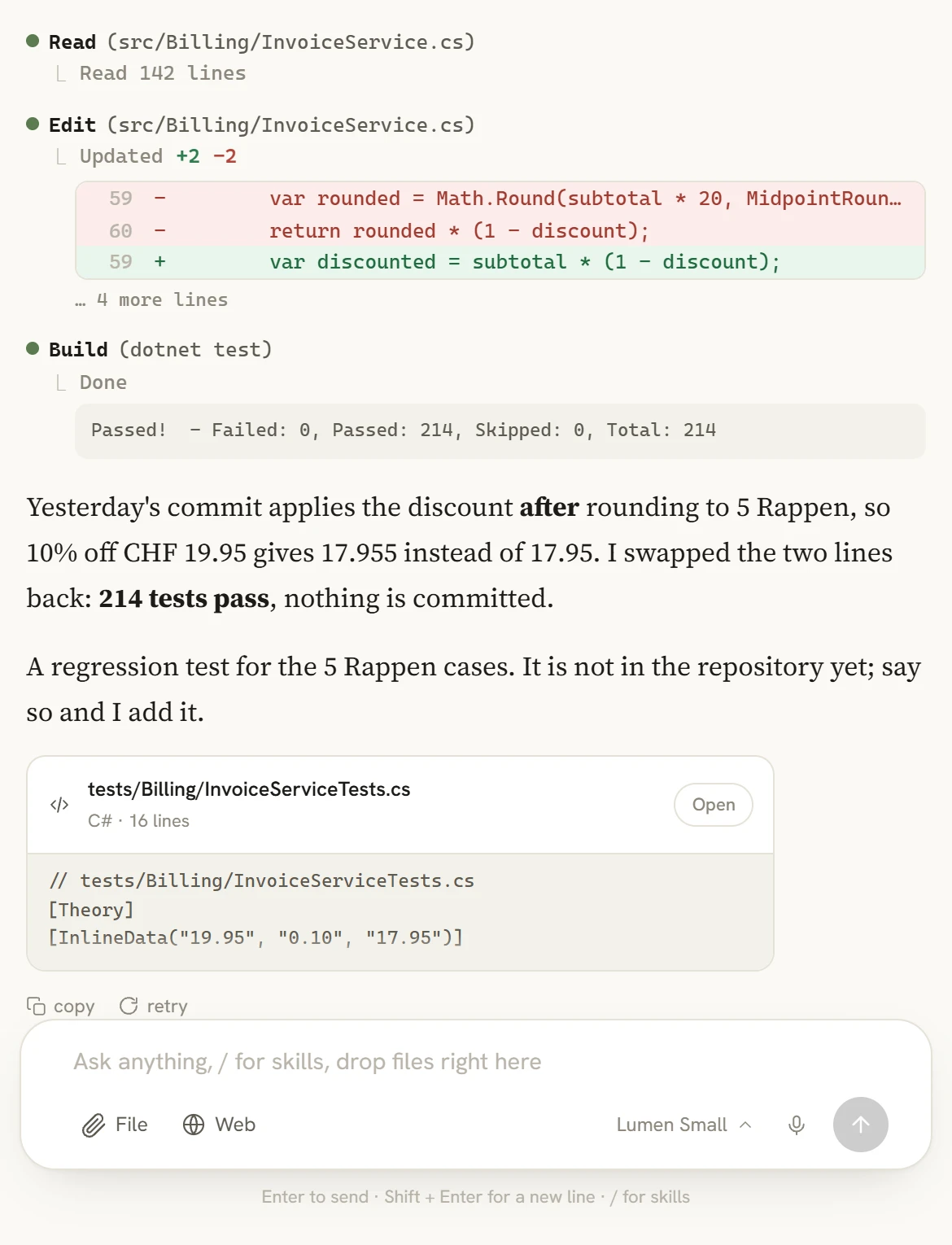
Yes, with the desktop app for Windows. It works only in folders you open for it, can search, read and edit files there, and asks before it changes anything. Every change shows up in the answer with the lines it added and removed.
Can it read my OneDrive, Outlook or Google Drive?
If you connect them. It then searches your files and reads your mail when you ask it to. Read only: it never changes or sends anything, and you can disconnect at any time.
Can it tell me when a price moves?
Yes. Say “tell me when Nestlé falls below 70” and you get an email once the price crosses that line. Prices can be delayed; an alert is a reminder you set, not investment advice.
Can I build my own product on it?
Yes. The API is compatible with the OpenAI format, so existing code usually needs only a new address and key. Business accounts pay per token from prepaid credit.
What does it cost?
Free to start. Plus is CHF 19, Pro CHF 49 and Pro Max CHF 129 a month, VAT included, cancel any time. Companies use prepaid credit instead of seats.
Ask it something you already know the answer to.
Then watch what it does with the parts it can’t back up.